Can Abacus Learning Help Autistic Children With Math?

Quick 4 -min read

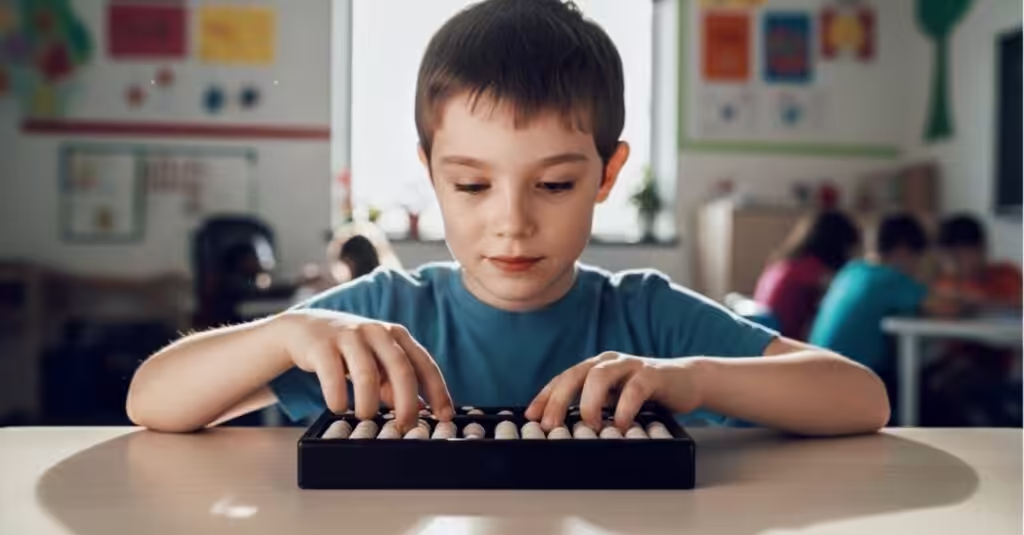
Child learning math with an abacus

Quick Answer: Can Abacus Learning Help Autistic Children?

Abacus learning may be a useful way for some autistic children to explore math. By making quantities visible and calculations hands-on, an abacus provides a concrete and engaging way to understand numbers and practise mathematical operations. 

The visual, hands-on nature of abacus learning, combined with its predictable steps, may help some children feel more comfortable and confident as they learn. Every autistic child has their own strengths, learning preferences and sensory needs, making it important to find an approach that brings out the best in them. 

The most important consideration is finding a learning approach that builds on a child’s strengths, supports their individual needs and makes learning math an enjoyable experience. 

Understanding Autism and Math Learning

Autism is a developmental difference that can influence how a person communicates, processes information, experiences sensory input and interacts with the world. 

Autistic children do not all learn in the same way. Some may enjoy visual information, while others may prefer spoken explanations, written instructions or hands-on activities. 

The US Centers for Disease Control and Prevention (CDC) notes that autistic people may have different ways of learning, moving and paying attention. 

This is why a flexible approach to teaching math can be valuable. 

For some children, visual learning tools and consistent routines can make mathematical concepts easier to explore. An abacus is one such tool, offering a physical representation of numbers that children can see and manipulate. 

Why Might Abacus Learning Suit Some Autistic Learners?

Kids using an abacus to learn math skills in class

An abacus uses beads to represent numbers. Children learn to move the beads according to specific mathematical rules, gradually building their understanding of number relationships and calculations. 

Here are some features that may make this approach worth exploring. 

Abacus feature 

Why it may be useful 

Important consideration 

Visible bead positions 

Makes quantities and number relationships concrete 

Some children may prefer other visual representations 

Consistent calculation steps 

Provides a repeatable way to approach a problem 

Flexibility is still important 

Hands-on learning 

Allows children to interact physically with numbers 

Touch and movement preferences vary 

Gradual progression 

Introduces skills in manageable steps 

The pace should suit the individual child 

Instructor feedback 

Provides opportunities to clarify and practise 

Ask about class size and individual support 

These features are educational possibilities, not guaranteed benefits for every autistic child. 

1. Numbers Become Visible

Math can sometimes feel abstract, particularly when a child is expected to work with numbers presented only on a page or through spoken instructions. 

An abacus makes quantities visible. 

Children can see how moving a bead changes a number, helping them explore mathematical relationships through a physical representation. 

Autism New Zealand’s resource, Making and Using Visuals, explains that visual supports can provide a concrete reference for children who find spoken information difficult to process or remember. 

An abacus may offer a similar kind of visual reference during math practice. 

2. A Consistent Method Can Make Learning Predictable

A 2020 review by Chunjie Wang, published in Frontiers in Neuroscience, examined studies investigating abacus-based mental calculation and its potential effects on cognitive functions and neural systems. 

The review discusses potential benefits related to mathematical performance, working memory and numerical processing. 

3. Learning Can Be Broken Into Smaller Steps

Instead of tackling a complicated calculation all at once, children can begin with individual bead movements and simple number patterns. 

As they become familiar with the method, they can gradually move towards more challenging calculations. 

This step-by-step approach can make it easier for a child to understand what is expected and practise one skill at a time. 

The New Zealand Ministry of Education’s Inclusive Education guidance also recommends presenting information in different ways and breaking tasks into manageable steps to support autistic learners. 

4. Hands-On Learning Offers Another Way to Explore Math

An abacus combines visual information with physical movement. 

For some children, interacting with a learning tool can make a concept easier to explore than relying exclusively on verbal explanations or written exercises.

What Does the Research Say About Abacus Learning and Cognitive Skills?

It is important to distinguish between research on abacus training in general and research specifically involving autistic children. 

What research on abacus training suggests

A 2020 review by Chunjie Wang, published in Frontiers in Neuroscience, examined studies investigating abacus-based mental calculation and its potential effects on cognitive functions and neural systems. 

The review discusses potential benefits related to mathematical performance, working memory and numerical processing. 

What research on visual learning suggests

Autism New Zealand and the New Zealand Ministry of Education provide guidance on visual supports and different ways of presenting information to autistic learners. 

These resources suggest that visual information, predictable routines and appropriate learning supports can help some children access and understand learning activities. 

This provides a useful educational rationale for exploring visual learning tools, including an abacus. 

It does not prove that abacus training itself improves autism-related outcomes. 

What Abacus Learning Does Not Do

Abacus training is an educational approach to learning math. 

It is not an autism treatment, does not change a child’s autism diagnosis and should not replace any specialist support recommended for the child. 

Speech-language therapy, occupational therapy, educational support and other services should continue according to the child’s individual needs. 

An abacus may be considered as an additional learning activity, provided it is enjoyable, accessible and appropriate for the child. 

For parents exploring learning approaches for children with ADHD, read our guide to abacus learning and ADHD.

What Should Parents Ask Before Choosing an Abacus Class?

If you are considering abacus classes for your child, it is worth asking a few practical questions before enrolling. 

  • Class size: How many children are in each class? 
  • Teaching approach: Can the instructor explain concepts in different ways? 
  • Sensory environment: Is the classroom noisy, busy or visually overwhelming? 
  • Pacing: Can children take more time when they need it? 
  • Breaks: Can a child pause or take a break during a lesson? 
  • Communication: How does the instructor communicate instructions and expectations? 
  • Trial classes: Can your child experience the learning method before you commit?

These questions can help you understand whether the class is likely to suit your child’s learning preferences. 

Key Takeaways

  • Abacus learning may be useful for some autistic children who enjoy visual and hands-on math activities. 
  • An abacus provides a concrete representation of numbers and mathematical operations. 
  • Consistent steps and gradual progression may make learning easier to approach for some children. 
  • Sensory preferences, communication styles and learning needs vary widely among autistic children. 
  • Abacus learning is an educational activity, not an autism treatment.

The best learning approach is one that helps your child feel comfortable, engaged and supported while developing their mathematical skills. 

Can Abacus Learning Really Help Autistic Kids?

Frequently Asked Questions

Can abacus learning help autistic children with math? 

Abacus learning offers a visual, hands-on way to explore numbers and mathematical operations. Some autistic children may find its structured approach helpful for developing math skills and confidence. Research on abacus training shows promising findings in general populations, although more research is needed to understand its specific benefits for autistic children. 

Why might visual math tools be useful for some autistic children?

Visual math tools make information easier to see, explore and refer back to during a learning activity. An abacus allows children to interact with numbers through visible bead movements, which may support understanding and engagement for some learners. The most effective approach is one that builds on the child’s individual learning preferences. 

Is an abacus suitable for every autistic child?

An abacus can be a worthwhile learning tool for autistic children who enjoy visual and hands-on activities. Its structured steps and gradual progression may offer an engaging way to practise math. A trial class can help parents and children discover whether the teaching method and learning environment are a good fit. 

Can abacus learning replace specialist autism support?

Abacus learning can be an additional educational activity that supports a child’s math learning alongside their existing educational and specialist support. Parents can discuss how it fits into their child’s broader learning goals with their educators and support team. 

Where to Find Abacus Classes in New Zealand

At SIP Abacus, we offer live, in-person and online abacus classes for children aged 5 to 12 across New Zealand. Our in-person classes accommodate a maximum of 12 children, while online classes have a maximum of 6. We keep our batch sizes small to ensure every child receives the attention they deserve. Classes are fully hands-on, with no homework. 

Our structured abacus learning approach introduces children to mathematical concepts through hands-on practice and gradually builds towards more advanced calculations. 

We aim to help children develop stronger math skills, concentration, memory and confidence through regular learning and practice. 

More than 5,000 Kiwi parents have trusted SIP Abacus to support their children’s learning journey. Among them are parents of autistic and other neurodivergent children who have shared encouraging experiences of their children’s progress. They have reported improvements in their children’s math skills, school performance, focus and confidence, highlighting how the right learning approach can help children build skills and enjoy learning. 

We understand that every child has different learning needs. If you are considering abacus classes for your autistic child, we encourage you to discuss their learning preferences with our team before enrolling. 

Our classes are designed to boost children’s learning skills, and we encourage parents to assess whether the teaching approach, class environment and learning pace are suitable for their child.  

See How SIP Abacus Supports Autistic and ADHD Children's Learning in New Zealand

Before Abacus my son was very silent, shy, and had low self-esteem when it came to doing maths and other subjects. My son is autistic and he’s very particular in how he works and how he wants his work presented. I remember the trial class and I told Harpreet, my son is special needs he needs a lot of work and he replied back , he’ll be fine. That was relief to my ears. I was told don’t worry, let us see what we can do to help. On his first day during trial class my son was calculating numbers when called out on a abacus. He’s never touched an abacus in his life but that few minutes he spent in that class room, he was calculating. I was amazed ever since that day my son has been attending twice a week, and each week he’s progressing.

User
Nastassja Salt
Mom of Axel Salt (11 years)

When my son came back from that trial session and proudly showed me what he learned, I knew right away that this abacus class was going to be a gamechanger for him!! In such short time, the teacher had already taught Peneueta how to use the abacus and keep up with the pace! As a mum, Ive noticed big improvements in his concentration and calculation skills and I just love how excited he is to show me everythng he’s learned. Thank you SIP Abacus! Youve reallyy exceeded my expectations.

User
Folose George
Mom of Peneuta (8 years).

I’m actually emotional writing this… my son Liam has ADHD… he used to dread math and we often had tearful evenings over homework. As a mom, it broke my heart to see him struggle. But since starting with SIP Abacus, i’ve seen such a change in him! The teachers are so kind & patient. Now Liam solves sums so confidentlyy and he even smiles while doing it A big, big thanks to the SIP Abacus team for making this transformation possible for my son!

User
Jisoo Malavite
Mom of Liam Malavite (9 years)

Honestly I was at my wits’ end with Minho. He’s autistic, and math was just a nightmare for him. Homework time was always filled with tears& frustration. But ever since we started SIP Abacus, wow!!! He actually looks forward to his abacus classes now, like, can you believe it?? He’s not just doing better; he’s having fun with it! I’m so so grateful for this change. I cant thank the amazing team at SIP Abacus for helping my boy shine!

User
Aria Heng
Mom of Minho Heng (6 years).

Still Unsure? Try a FREE Trial Class!

A free SIP Abacus trial class is a great way to experience the program before enrolling.  

Your child gets to explore the abacus hands-on, while you discover how SIP Abacus supports learning and complements your child’s school curriculum. 

You can also observe how they respond to the learning environment and discuss their learning preferences with the instructor.

We Boost Lifelong SIPerPowers in Your Child!

Hear It From Parents of Children with ADHD

Before Abacus my son was very silent, shy, and had low self-esteem when it came to doing maths and other subjects. My son is autistic and he’s very particular in how he works and how he wants his work presented. I remember the trial class and I told Harpreet, my son is special needs he needs a lot of work and he replied back , he’ll be fine. That was relief to my ears. I was told don’t worry, let us see what we can do to help. On his first day during trial class my son was calculating numbers when called out on a abacus. He’s never touched an abacus in his life but that few minutes he spent in that class room, he was calculating. I was amazed ever since that day my son has been attending twice a week, and each week he’s progressing.

User
Nastassja Salt
Mom of Axel Salt (11 years)

When my son came back from that trial session and proudly showed me what he learned, I knew right away that this abacus class was going to be a gamechanger for him!! In such short time, the teacher had already taught Peneueta how to use the abacus and keep up with the pace! As a mum, Ive noticed big improvements in his concentration and calculation skills and I just love how excited he is to show me everythng he’s learned. Thank you SIP Abacus! Youve reallyy exceeded my expectations.

User
Folose George
Mom of Peneuta (8 years).

I’m actually emotional writing this… my son Liam has ADHD… he used to dread math and we often had tearful evenings over homework. As a mom, it broke my heart to see him struggle. But since starting with SIP Abacus, i’ve seen such a change in him! The teachers are so kind & patient. Now Liam solves sums so confidentlyy and he even smiles while doing it A big, big thanks to the SIP Abacus team for making this transformation possible for my son!

User
Jisoo Malavite
Mom of Liam Malavite (9 years)

Honestly I was at my wits’ end with Minho. He’s autistic, and math was just a nightmare for him. Homework time was always filled with tears& frustration. But ever since we started SIP Abacus, wow!!! He actually looks forward to his abacus classes now, like, can you believe it?? He’s not just doing better; he’s having fun with it! I’m so so grateful for this change. I cant thank the amazing team at SIP Abacus for helping my boy shine!

User
Aria Heng
Mom of Minho Heng (6 years).

See the Difference in the Trial Class Itself. It’s FREE!

Book a FREE trial class today and watch your child light up with confidence, focus, and a love for learning!

Your Free Trial

Smart Reads,
Straight to Your Inbox

Related Posts

Pack it once. Keep them fuelled all afternoon. Discover four simple, balanced lunchbox ideas for Kiwi kids.
Abacus Classes | SIP Abacus NZ
SIP Abacus Trial Class & Parent Information Session
  • SIP Abacus Demo – 15 min
  • Free Trial Class & Assessment for Children
  • Simultaneous Parent Information Session – 75 min

Select your preferred location for the trial class*

Flat Bush
Mt. Roskill
Hamilton
Takanini
Henderson
Howick
Online
Epsom & Remuera
Manurewa
Papatoetoe
Hillcrest
(North Shore)
Moorhouse
(Christchurch)
New Lynn
Pukekohe
Flat Bush
Mt. Roskill
Hamilton
Takanini
Hillcrest (North Shore)
Henderson
Moorhouse (Christchurch)
Epsom & Remuera
Online
Papatoetoe
Manurewa
Howick
New Lynn
Pukekohe

Wait!

Get a Free Trial Class


    Leave your name and number and we’ll call you to book a free trial class